
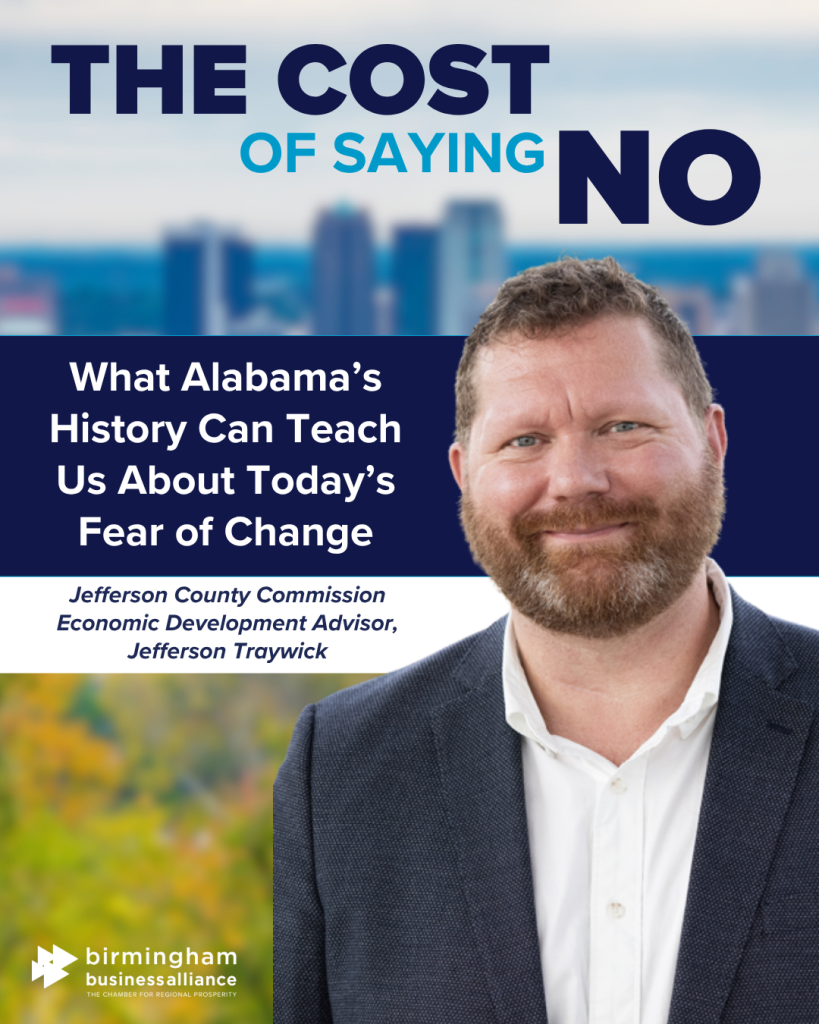
Jefferson Traywick is the Jefferson County Commission Economic Development Advisor, and a member of our Regional Economic Development Allies (REDA), which is a group convened by the BBA that brings together economic development professionals from across Central Alabama to collaborate, share insights, celebrate successes and strengthen our region’s competitiveness.
Every generation seems to believe it is facing challenges unlike any that came before it. New industries emerge, new technologies disrupt familiar ways of life, and communities are asked to make decisions that will shape their future for decades. Those moments are rarely comfortable and often face opposition and fear. We are forced to weigh opportunity against uncertainty, and to imagine both the promise of success and the consequences of failure.
There is nothing wrong with that process. In fact, healthy skepticism is essential to good government. Citizens should ask difficult questions. Elected officials should insist on transparency, demand rigorous environmental review, develop and maintain good planning and zoning requirements, and carefully evaluate whether public investments are justified. Communities that stop asking questions can be just as vulnerable as communities that refuse to embrace change.
But when skepticism gives way to pessimism, good opportunities can be stopped dead in their tracks, economic growth can stall or retract, and the lives of our citizens can be harmed in ways that can have decades of negative impact.
Too often, public debate becomes consumed by what might go wrong while giving little consideration to what could be gained or even what could be lost if opportunity slips away. The loudest voices are often those predicting catastrophe, however careful study of our economic history reminds us that many of Alabama’s greatest successes were once greeted with the very same fears we hear about large-scale projects today.
That history is worthy of study because it reveals a pattern that has repeated itself for decades.
When Mercedes-Benz announced in 1993 that it was considering Alabama for its first North American manufacturing facility, the reaction was anything but unanimously positive. The proposed incentive package drew sharp criticism from across the political spectrum. Many questioned whether taxpayers should help finance the recruitment of one of the world’s largest automobile manufacturers. Others argued that Alabama lacked the skilled workforce needed to produce luxury automobiles and predicted we could not adapt to meet the demands of modern manufacturing. Some national commentators openly mocked the idea that Mercedes would entrust its reputation to a state better known for cotton, coal, and football than precision manufacturing.
Looking back today, those criticisms seem almost laughable. Mercedes did not simply build a factory in Tuscaloosa County; it fundamentally altered Alabama’s economic trajectory. The company’s investment demonstrated to the rest of the world that Alabama could compete for advanced manufacturing on a global stage. Suppliers followed. Honda followed. Hyundai followed. Toyota and Mazda eventually followed as well. Tens of thousands of Alabamians found careers that did not exist just a few years earlier, and an entirely new industrial ecosystem emerged because one controversial decision was allowed the opportunity to prove itself.
The same story unfolded multiple times in the Birmingham Metro.
When George Barber announced plans to build what would become Barber Motorsports Park, many people questioned whether such a facility belonged in Alabama at all. Environmental organizations expressed concerns about the potential impact on the Cahaba River watershed claiming the project would harm the watershed and our drinking water. Efforts to pack zoning hearing with residents armed with signs, showing similar slogans to what we are seeing today with data center projects, were led by environmental and community groups. Others doubted that anyone would travel across the country, much less around the world, to attend races in central Alabama. To many pessimists, the project seemed like an expensive gamble with uncertain returns.
Today, Barber Motorsports Park is internationally recognized as one of the finest road racing facilities in North America. It attracts visitors from across the globe, hosts premier racing events, hosts the official U.S. driving school for Porsche, supports local hotels, bars and restaurants, and has become one of the Birmingham area’s defining attractions. It has appeared in numerous commercials and advertising campaigns for the likes of Hyundai, Xbox, Ford, and DJI. What was once viewed by many as an unnecessary risk has become an enduring source of regional pride.
The Robert Trent Jones Golf Trail followed a remarkably similar path. When the Retirement Systems of Alabama announced plans to build a network of championship golf courses across the state, critics questioned both the wisdom of the investment and the premise behind it. Alabama, they argued, was not a golf destination and never would be. Yet today the Trail is widely credited with transforming the state’s tourism industry, attracting millions of visitors while generating economic activity that few imagined when the idea was first proposed. Many of the business leaders involved in our state’s economic development recruiting efforts had their first introduction to our state via the Golf Trail.
Airbus in Mobile, Honda in Lincoln, Hyundai in Montgomery, Railroad Park, and Regions Field all encountered their own versions of public skepticism. Some critics questioned the use of public incentives. Others doubted the demand, the business model, or the ability of Alabama to compete in industries traditionally associated with other parts of the country. Yet each of these projects ultimately demonstrated that communities willing to think beyond their present circumstances can fundamentally reshape their future.
Our history offers yet another lesson that is discussed far less often. While we frequently celebrate projects that overcame opposition, we spend very little time examining the opportunities that were delayed, diminished, or lost altogether because communities struggled to adapt to changing economic realities. These stories rarely become the subject of ribbon cuttings or anniversary celebrations, but they deserve equal attention because they reveal another kind of risk, one that is often invisible until it is too late. Perhaps nowhere is that lesson more evident than in Birmingham’s steel industry.
For much of the twentieth century, Birmingham stood among the great steel-producing cities of the United States. Blast furnaces illuminated the night sky. Coke ovens, rolling mills, and foundries employed generations of workers whose wages built neighborhoods, churches, schools, and businesses throughout the region. The steel companies themselves established many of our city’s early hospitals. Steel was not simply an industry; it was the economic foundation upon which much of the Birmingham Metro was built.
By the 1970s, however, the global steel industry had begun to change. The nationalization of U.S. Steel’s iron ore mines in Venezuela led to increased raw material costs, the aged blast furnace process was more inefficient, less flexible and dirtier that more modern methods of production. International competitors invested heavily in newer production methods, modern facilities, and technologies that dramatically reduced operating costs while increasing flexibility. Electric arc furnaces offered producers the ability to manufacture steel more efficiently by recycling scrap metal rather than relying entirely on iron ore as with traditional coke-fired blast furnaces.
Transitioning to those newer technologies was enormously complicated. Modernization required substantial capital investment, significant organizational change, and the difficult reality that some long-established jobs and practices would inevitably evolve. Fears of job losses due to the new technology directly impeded U.S. Steel’s plans to install electric arc furnaces at their Fairfield Works in the early 1980s. The New York Times covered this controversial proposal in a series of articles, documenting the threat of worker shutdowns if modernization plans moved forward. In the end, the company chose not to move forward with the investment, trying to maintain operations with technology that would not allow them to compete in an increasingly competitive environment.
The outcome is impossible to ignore. As competitors modernized, much of Birmingham’s integrated steel industry struggled to remain competitive. Plants closed, furnaces went cold, and entire communities watched their economic foundation erode over the course of a few years. Tens of thousands of jobs disappeared as the region’s once-dominant industry contracted, leaving behind a lasting economic and social impact that is still visible today.
The irony is difficult to overlook as the technology that ultimately became essential to remaining competitive eventually arrived in Birmingham anyway. Electric arc furnace technology is now used to produce steel at the Fairfield Works. But by the time that transition occurred, decades later, much of the employment base that had once defined the region had already been lost.
That history illustrates a truth that extends far beyond the steel industry. Communities naturally fight to preserve the economy they know. People fear change because change often carries real costs, particularly for workers whose livelihoods depend upon existing industries. Those concerns deserve respect and thoughtful consideration. Yet history repeatedly demonstrates that refusing to adapt to changing economic realities can ultimately produce far greater losses than adapting to them.
This brings us to an important question that communities rarely ask themselves.
When a major project is proposed, nearly every public discussion revolves around the possibility that approving it could prove to be a mistake. We ask whether the incentives are too generous, whether environmental impacts have been adequately studied, whether promised jobs will materialize, and whether taxpayers are assuming unnecessary risk. Those are all legitimate questions, and they should be asked every single time.
What we ask far less frequently is an equally important question: What happens if we are wrong about saying no? What if the project we reject becomes the industry that defines another community’s economic success? What if the jobs, investment, tax base, and innovation simply locate across a state line? What if the companies that might have clustered around that investment never even consider us because the anchor project was lost?
Those opportunities rarely make headlines because they never happen. Yet those unseen opportunities may represent some of the most consequential decisions a community ever makes.
As Alabama debates the next generation of transformative investments, whether they involve advanced manufacturing, aerospace, biotechnology, artificial intelligence, energy infrastructure, or data centers, we should remember both halves of our own history. We should certainly remember the projects that were greeted with doubt before becoming pillars of our economy. But we should also remember the impacts resulting from our fear of adapting to a changing world and desire to maintain a status quo that led to massive unforeseen consequences. Consequence that destroyed the economic prosperity for thousands of area families and dozens of communities.
None of this suggests that every proposed development deserves automatic approval. Communities should never abandon careful analysis in favor of blind optimism. Every project should stand on its own merits, and every developer should be expected to demonstrate that the promised benefits justify the public’s trust.
However, our analysis should be complete and should weigh not only the risks of moving forward, but also the risks of standing still. We should distinguish between evidence and speculation, between measurable impacts and imagined catastrophes, and between temporary discomfort and long-term prosperity. Most importantly, we should recognize that history is filled with examples showing that fear, while entirely understandable, has rarely been the most reliable guide to Alabama’s future.
If there is one lesson that echoes through our state’s economic history, it is this: the greatest mistake is not always approving the wrong project. Sometimes, the greatest mistake is allowing fear to prevent us from recognizing the right one.
History has already taught us that lesson. The question is whether we are willing to learn from it.