
BBA’s D.C. Policy Forum

D.C. Policy Forum

BBA DC Policy Forum | May 12-14, 2025

Thank you for joining us for the BBA’s 2025 DC Policy Forum. This exclusive opportunity allows you to engage directly with members of Congress on issues critical to the Greater Birmingham Region and the State of Alabama. Our advocacy efforts this trip will focus on advancing the Birmingham Northern Beltline and strengthening support for New Market Tax Credits and Opportunity Zones. These priorities represent essential components of our broader strategy to promote sustainable economic growth and regional competitiveness.

Agenda & Briefing Packet

From the button below, you will find detailed information regarding each scheduled session, location and timing associated with the BBA’s DC Policy Forum. We encourage you to reference this page regularly throughout your time in Washington, D.C., as it will serve as your central resource for all event logistics and updates. View Agenda & Briefing Packet Here

Key Talking Points

Birmingham Northern Beltline Expand

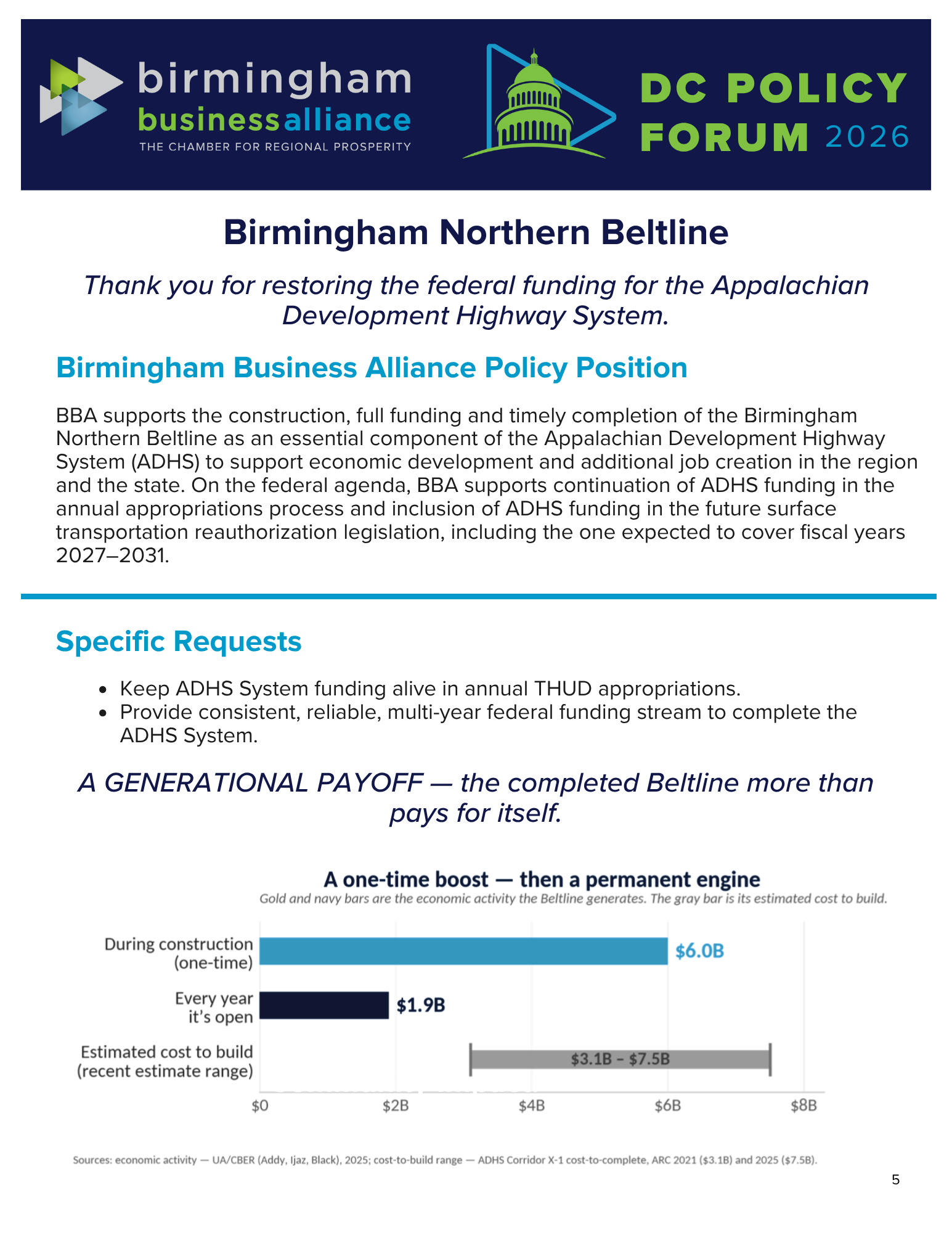
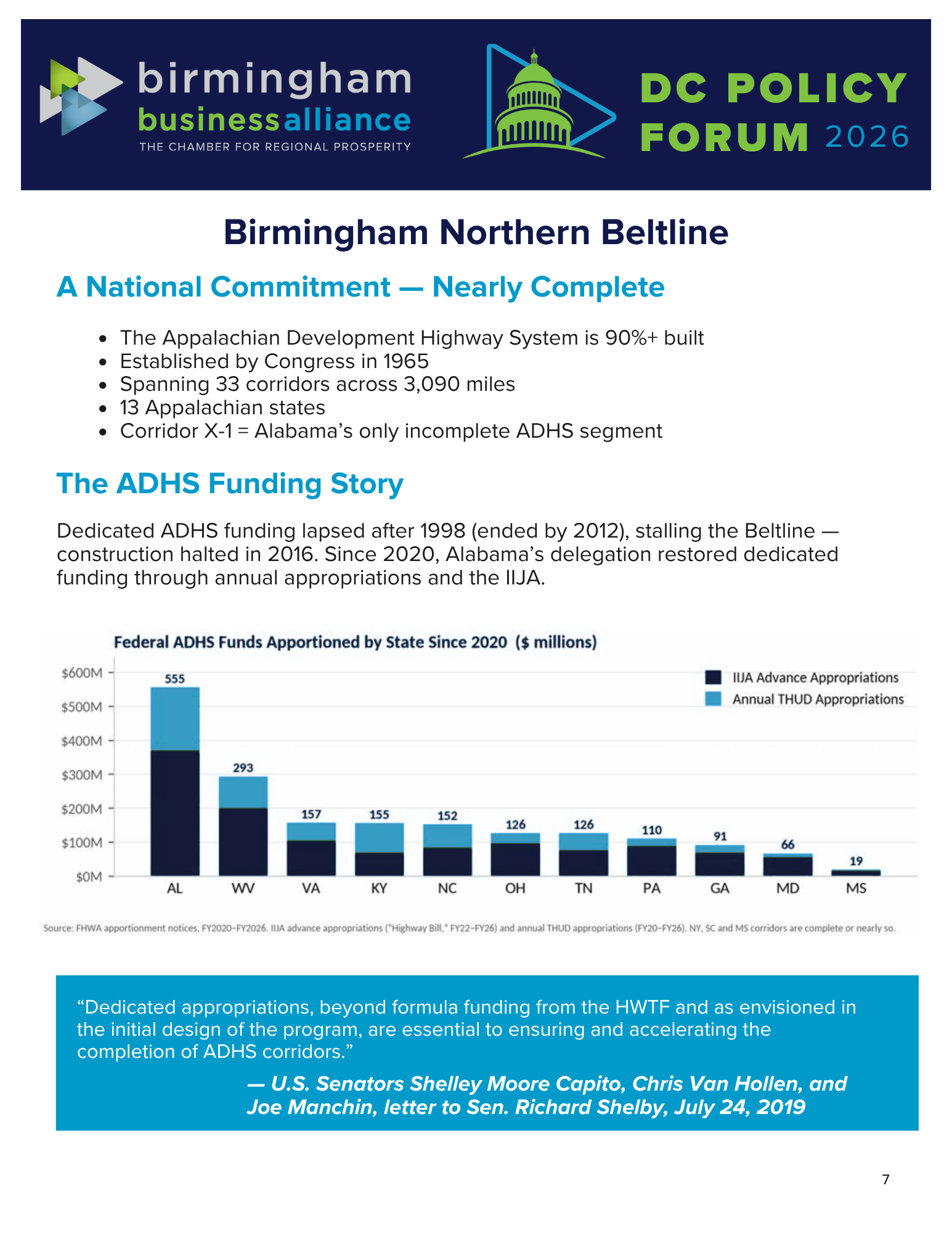
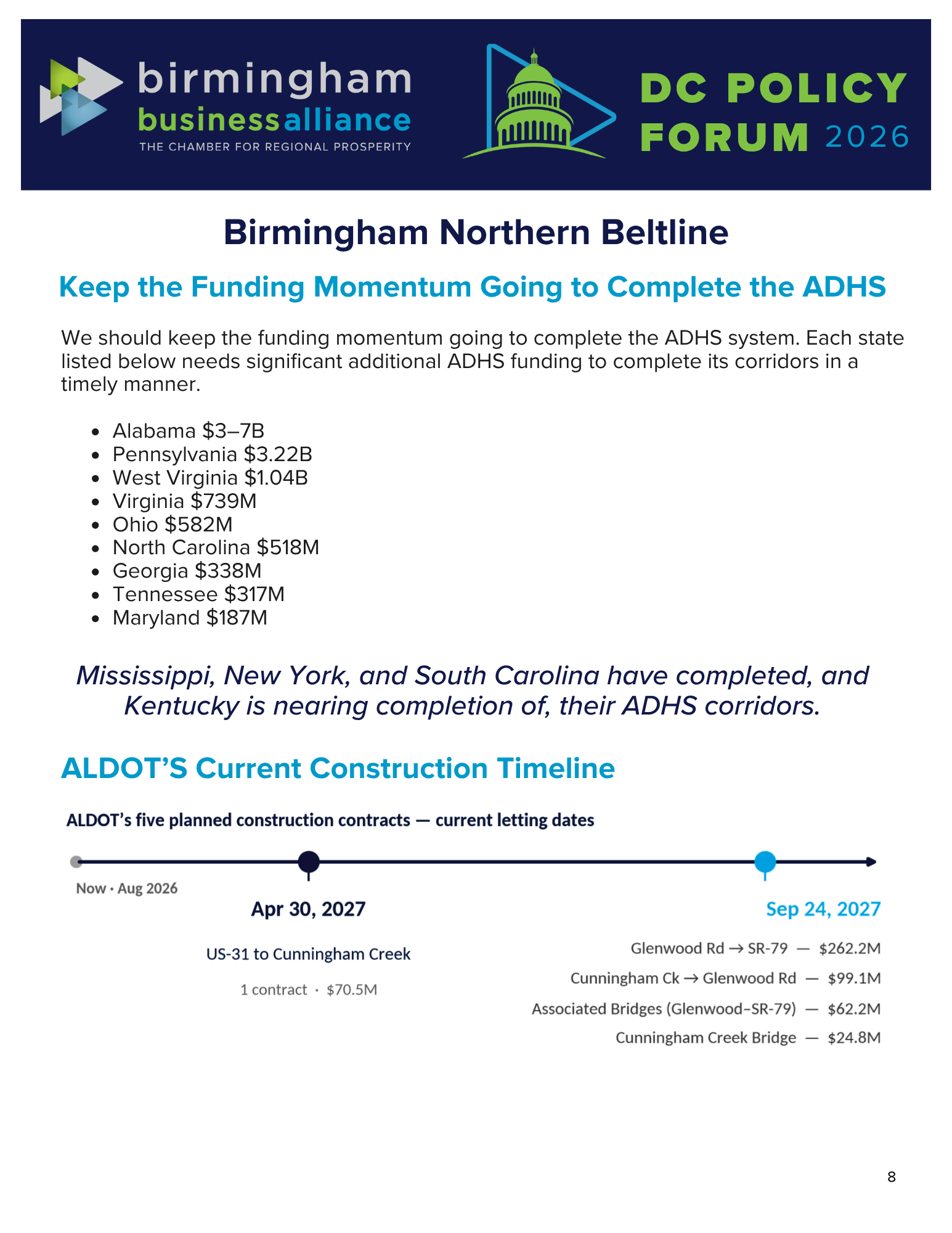
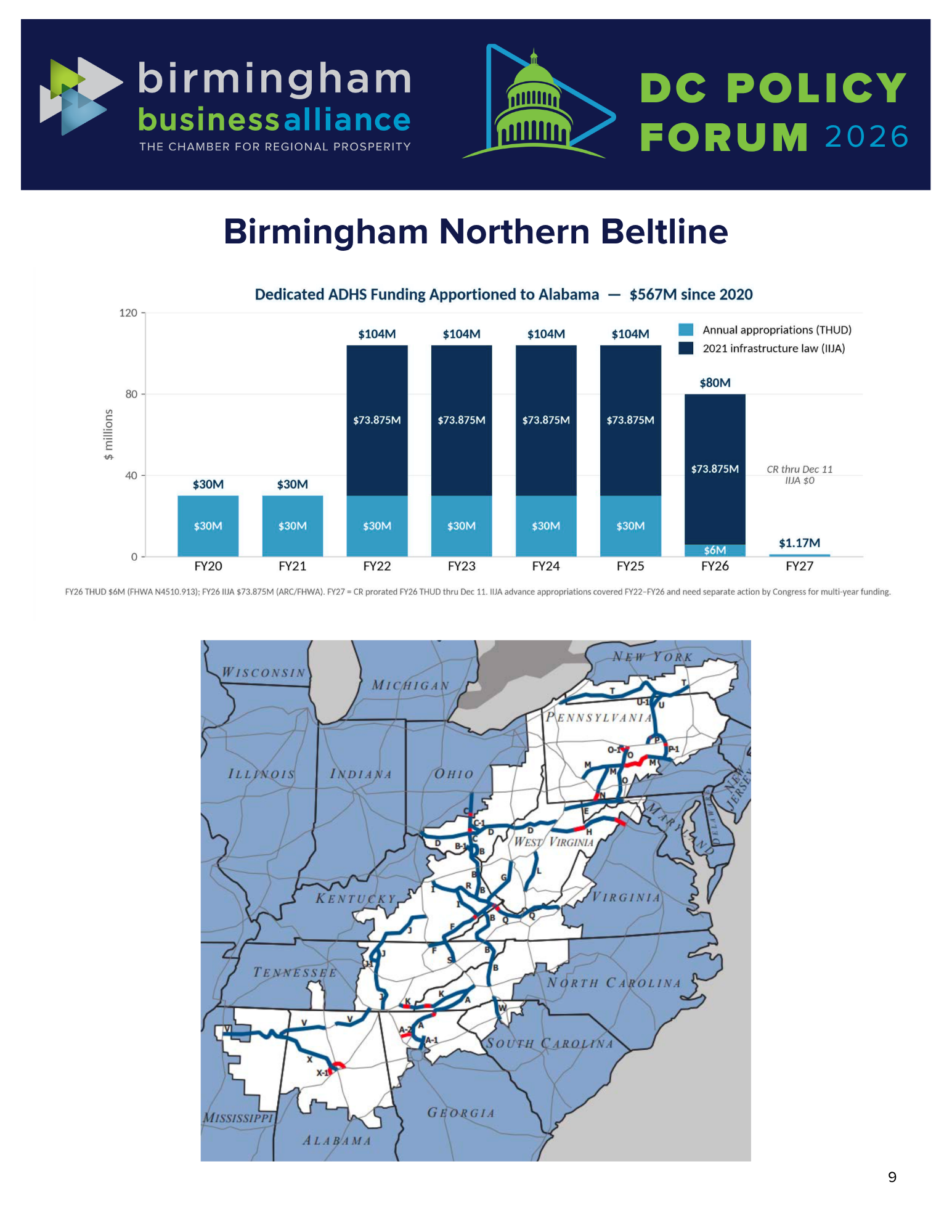
Thanks to the Alabama delegation for leading a bipartisan, bicameral effort since 2020, restoring dedicated Appalachian Development Highway System (ADHS) funding and providing approximately 20% of funding needed for completion.

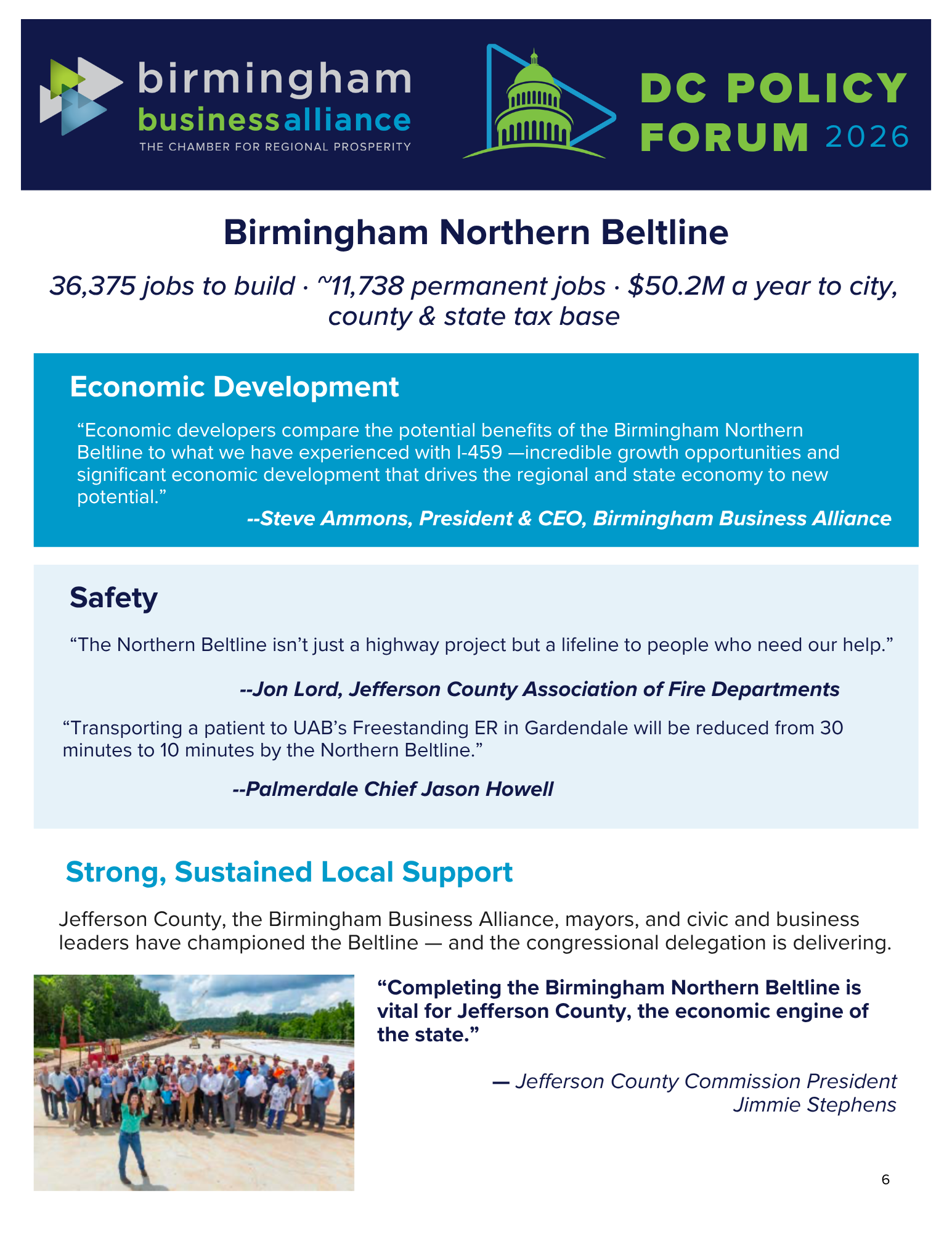
The Northern Beltline (ADHS Corridor X-1) construction is underway and leaders are working to identify leveraging opportunities to accelerate completion of the ultimate 52-mile corridor.

Northern Beltline Congressional Requests:

(1) Support ADHS Funding in the House and Senate FY2026 THUD Appropriations bills. Congressman Robert Aderholt is leading a House Member letter.

(2) Support ADHS funding in the successor to the IIJA, which will fund highway programs from FY2027-2031.

Appalachian Development Highway System

(see map below):

  • ADHS was established by Congress in 1965 to better integrate Appalachia with the Midwest, mid-Atlantic and Southeast Regions of the U.S.
  • ADHS is made up of 33 corridors, spanning 3,090 miles, across 13 Appalachian states, with construction over 90% complete.
  • Corridor X-1, the Birmingham Northern Beltline, is Alabama’s only incomplete ADHS segment.
  • The ADHS system is a major federal commitment that is over 90% complete, and according to ARC’s ADHS completion analysis, “completion of the ADHS is estimated to create 47,000 more jobs and add $8.7 billion in goods and services annually across the 13 Appalachian states.” 

The President’s Budget continues funding to the Appalachian Regional Commission, a small agency that plays a major role in administration of the ADHS. The White House acknowledges that “ARC serves a region uniquely hard-hit by the loss of good coal mining jobs and the opioid crisis.”

ADHS Funding History:

  • 1965 to 1998: Direct annual federal appropriations to the ADHS system funded it to 75% completion.
  • 1998 to 2020: ADHS funding transitioned from receiving direct annual appropriations to being an eligible Highway Trust Fund activity, forcing states to delay ADHS construction timelines for decades. Construction of the Northern Beltline was halted in 2017 due to a lack of federal funding.
  • 2020 to 2025: The Alabama delegation led a bipartisan, bicameral effort that gained support from across Appalachia, restoring dedicated funding to the ADHS System through annual appropriations and the most recent highway bill (IIJA).
  • Funding may only be used for ADHS Corridor Construction.
  • Funds are 100% federal, no state match required.
  • Dedicated funding, beyond formula funding from the Highway Trust Fund.  


 New Market Tax Credits Expand

Position:

Congress should make permanent the New Market Tax Credit program and direct agencies to qualify areas based on 2011-2015 census data.

Why make permanent?

Since program inception in 2003, over 149 projects for facilities or businesses in Alabama have received financing totaling $2.46 billion in total project financing. Over 10,000 full-time jobs have been created as a result.

The program has well earned becoming a permanent part of the Federal economic development toolkit as its impact for attracting capital to low-income areas is well established.

The Qualifying Areas Problem:

Recently, the Federal Government changed the map of areas determined eligible for use of New Markets Tax Credits. A number of previously eligible New Market Tax Credit census tracts (based on the 2011-2015 data) are now ineligible based on the 2016-2020 data.

The Impact:

This change has removed certain communities and related programs from eligibility for many of these state-level incentives. These include important census tracts in Birmingham and Montgomery (though many other communities throughout the state are also impacted):

  • Downtown Birmingham (Tract 01073002701) – This tract includes the 4th Ave Historic Civil Rights Business District, the Switch District and Innovation Depot.
  • SW Section of UAB (Tract 01073004501) – This tract includes portions of UAB’s campus.
  • Downtown Montgomery (Tract 01101000100) – This tract includes RSA Tower, Montgomery City Hall, the Convention Center, the Riverwalk and The Lab on Dexter.

Solution:

Guidance in law to base NMTC qualifying areas on 2011-2015 data.Opportunity Zones Expand

What Are Opportunity Zones?

Opportunity Zones (OZs) were created under the 2017 Tax Cuts and Jobs Act to spur long-term private investment in underserved and economically distressed communities. Investors who reinvest capital gains into Qualified Opportunity Funds (QOFs) can receive tax advantages, including deferral, reduction and potential exclusion of those gains – when they support real estate or business development in federally designated OZs.

Why Opportunity Zones Matter to the Birmingham Region

The Birmingham region includes dozens of designated Opportunity Zones, located in both urban and suburban areas, that have historically experienced disinvestment.

These zones represent a powerful tool to:

  • Attract risk-tolerant private capital
  • Stimulate job creation, housing and entrepreneurship
  • Revitalize neglected commercial corridors and industrial sites
  • Ensure inclusive, place-based economic growth across communities

For the BBA and its partners, OZs align with our mission to build a prosperous, inclusive and regionally competitive economy.

Where Are the Opportunity Zones in the Birmingham Region?

OZs are strategically distributed across the Birmingham metro, including:

  • Birmingham – 24 zones across neighborhoods like Downtown, Smithfield, Ensley, Woodlawn, East Lake, and the CrossPlex district
  • Bessemer – Industrial and logistics-focused corridors
  • Fairfield – Historic commercial districts with redevelopment potential
  • Fultondale – Proximity to workforce pipelines and interstate access
  • Tarrant – Legacy industrial zones ready for reinvestment
  • Midfield – Mixed-use and neighborhood-scale commercial opportunities
  • Homewood – Targeted areas for small business and mixed-use development
  • Irondale – Transit-accessible, growth-ready parcels
  • Leeds – Sites along logistics corridors with retail potential
  • Center Point – Community-focused revitalization areas

These cities share transportation networks, labor pools and regional priorities-making OZs a regional opportunity, not just a city-by-city strategy. 

Regional Collaboration & Incentives

The BBA is positioned to lead on aligning regional OZ efforts. Through our relationships with municipalities, developers, and investors, we can:

  • Convene key stakeholders across jurisdictions
  • Match capital with investment-ready sites and developers
  • Promote high-impact, inclusive development projects

OZs can also be layered with other tools, such as state incentives, NMTCs, or historic tax credits, to further improve project feasibility. Collaboration across city lines ensures OZs contribute to a unified regional economic vision.

Why Congressional Reauthorization Matters

As of 2023, several key OZ incentives, especially the 10-year capital gains exclusion, have expired for new investments. Without Congressional action, Birmingham and peer cities risk losing momentum at a critical time.

Reauthorization would:

  • Extend timelines for new investments
  • Reinstate and strengthen tax incentives
  • Add transparency and reporting requirements to increase public confidence
  • Ensure communities still building investment pipelines aren’t left behind

Mid-sized markets like Birmingham are just hitting their stride. Reauthorization would keep these communities competitive and allow projects to scale.

Why Reauthorization Is Especially Important for the Birmingham Region

Unlike early adopters, many OZ projects in Birmingham are in the early or planning stages.

Reauthorization is essential to:

  • Maintain capital interest in our region
  • Ensure long-term projects have time to mature
  • Revitalize historically overlooked neighborhoods with real resources
  • Compete effectively with regions like Nashville, Charlotte, and Raleigh

Opportunity Zones represent a once-in-a-generation chance to change the trajectory of Birmingham’s underserved areas. We must not allow that window to close prematurely.

Other Need to Know Information

Prohibited Items

To maintain safety at the U.S. Capitol, Capitol Grounds, House Office Buildings and Senate Office Buildings, certain items are prohibited inside the buildings and on the grounds. Attendees should leave restricted items at home to ensure smooth security screenings. View List Here

U.S. Capitol Visitor Center Map

CVC_SystemMap_South Door

Weather

Please plan accordingly for mild, humid weather conditions in DC ranging from 65 to 76 degrees F and a chance of rain on Tuesday, May 13 and Wednesday, May 14. Click for Forecast

BBA’s DC Policy Forum Attendees

  • Birmingham Business Alliance President & CEO Steve Ammons 
  • Brasfield & Gorrie, LLC Business Development Frank Anderson 
  • Jefferson County Commissioner Mike Bolin
  • Jefferson County Commission Chief of Staff Danielle Cater 
  • Vulcan Materials Vice President of External Affairs Janet Kavinoky
  • Master Solutions, LLC President Daryl Perkins
  • Alabama Power Company Community Relations Manager Anna Catherine Roberson 
  • Milo’s Tea Company Vice President of Corporate Communications Atticus Rominger 
  • Chain Link Solutions President Michael Staley 
  • Fortif Law Partners Attorney Gabe Tucker
  • PNC Bank Greater Alabama Regional President Nick Willis
  • Spire Director of Government Affairs Chase Wright

BBA Staff Contact Information

4
5
6
7

Thank you, Sponsors!

2
3

Questions?

Get in touch with our Public Policy team! Email