
Why Birmingham’s Economic Future Depends on Regional Alignment
(This article was originally published by ComebackTown and later featured in Birmingham Business Journal and AL.com.)
By Steve Ammons
Economic competition today doesn’t happen city by city.
It happens region against region.
Companies evaluating where to invest aren’t comparing one municipality to another.
They’re comparing metropolitan areas, looking at workforce size, infrastructure, talent pipelines, quality of life, and economic momentum. In other words, they’re evaluating regions.
That reality is exactly why the Birmingham Business Alliance (BBA) operates across seven counties. It reflects how the modern economy actually works, and how regions must organize themselves if they want to compete for the next generation of jobs, talent, and investment.
A recent analysis the BBA conducted, “A Shared Economic Future,” reinforces something many people instinctively understand, but we don’t always fully act on: the success of each community in our region is tied to the success of the region as a whole.
People live in one community, work in another, and spend their money somewhere else entirely. Employers recruit talent from across county lines. Supply chains stretch across municipalities. Infrastructure investments influence commuting patterns and economic activity well beyond the jurisdiction where they are located.
The regional economy is already interconnected. The question is whether our thinking and our actions reflect that reality.
Across the country, the regions gaining ground are the ones that have figured this out. They align around shared priorities. They coordinate economic development strategies. And they speak with a consistent voice about who they are and where they are going.
They compete together. Meanwhile, regions that spend more time competing internally often find themselves losing opportunities.
This doesn’t mean communities give up their identity or priorities. Every city and county in the Birmingham region has unique assets and opportunities. But successful regions recognize that alignment creates momentum and momentum attracts investment.
When a major employer looks at Birmingham, they are not evaluating a single municipality. They are evaluating the strength of the entire regional market, its workforce, infrastructure, industry sectors, and long-term trajectory.
If we want those companies to see a region that is confident, coordinated, and forward-looking, we have to act like one.
That is the thinking behind “A Shared Economic Future”, the “why”. It underscores our ability to compete for jobs, talent, and investment will increasingly depend on how well we align across jurisdictions and institutions. Workforce development, transportation infrastructure, industry growth, and talent attraction are challenges and opportunities that extend beyond any single community.
Accelerate 2030, the Birmingham Region’s strategic framework, outlines the “how.” The regions that win in the coming decade will be the ones that align their leadership, resources, and vision.
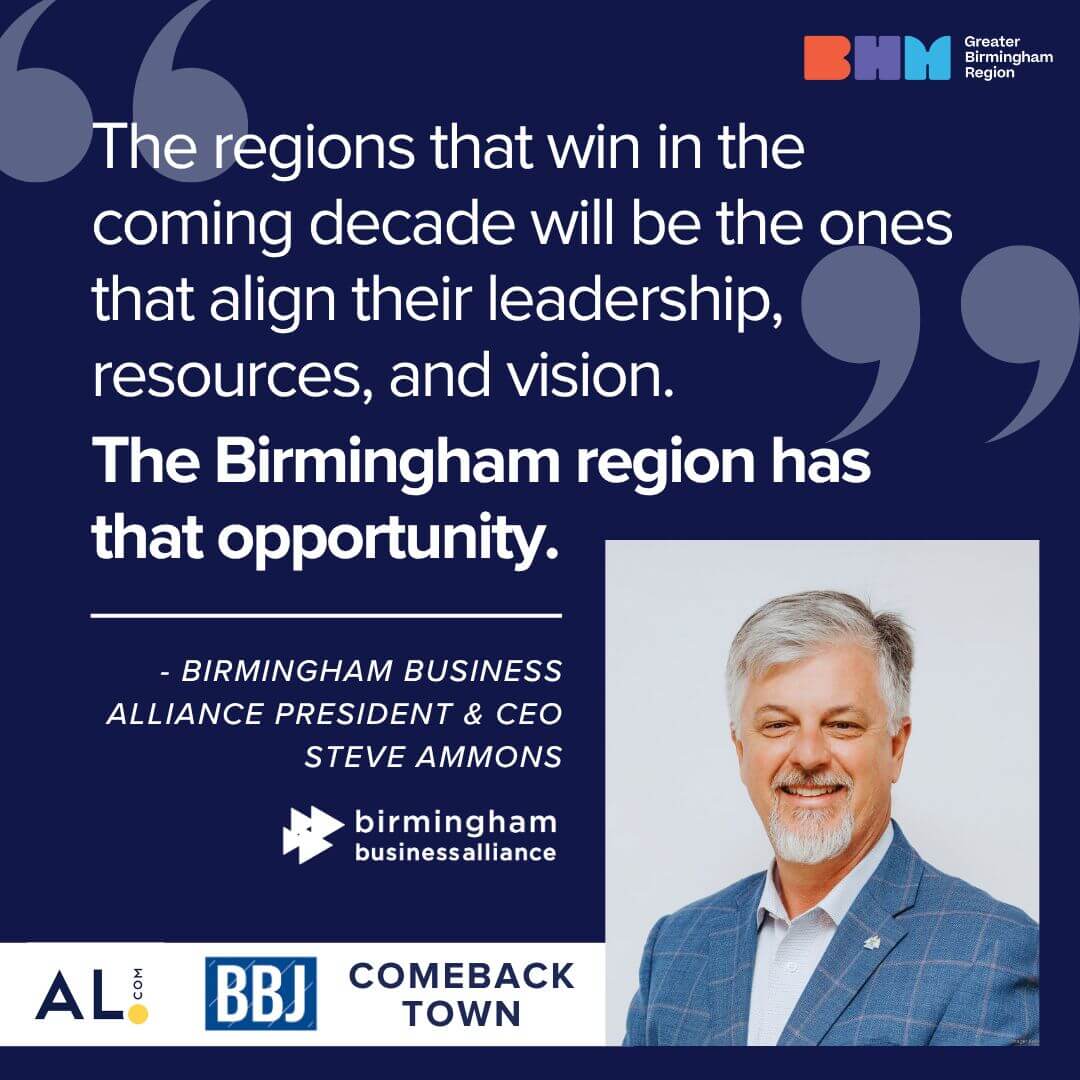
The regions that win in the coming decade will be the ones that align their leadership, resources, and vision. The Birmingham region has that opportunity.
The question is whether we choose to embrace it. Strong Economies are Regional Economies. Not a tagline.
To learn more about the “why” and the “how,” visit www.birminghambusinessalliance.com/regional-advantage.
Steve Ammons is the President and CEO of the Birmingham Business Alliance (BBA), where he leverages a deep commitment to economic development, public service, and collaborative leadership to drive Birmingham’s growth. The BBA is the chamber of commerce and economic development organization for the Greater Birmingham Region.