

Data Debrief on Why Birmingham Is Standing Out for Recent College Graduates
The Greater Birmingham Region is gaining national recognition as a place where recent college graduates can launch successful careers – and the data helps explain why.
Recently, The Wall Street Journal (WSJ) highlighted Birmingham as one of the nation’s top metros for young professionals entering the workforce, drawing from research published by this ADP Research publication: 2026 You’ve Graduated. Now what?. The analysis focused on three key factors shaping opportunity for graduates: wages, hiring activity, and affordability.
To better understand the national recognition, the Birmingham Business Alliance’s BHM IQ, our data-driven intelligence center, conducted additional analysis around the factors driving Birmingham’s momentum.
- Wages
- Anonymized ADP payroll data covering 409,000 workers aged 20–29 across more than 20,000 U.S. employers
- Hiring Rates
- Measures pace of employer expansion for degree-requiring roles by comparing the number of people aged 20 to 29 who were hired into jobs that typically require a bachelor’s degree with the number of people in that same group who were employed in those jobs
- Affordability
- ADP Research used the Metro Area Regional Price Parities (MARPP) data from the U.S. Bureau of Economic Analysis to calculate affordability
- ADP Research provided both annual wage estimates and cost of living (affordability) adjusted wages
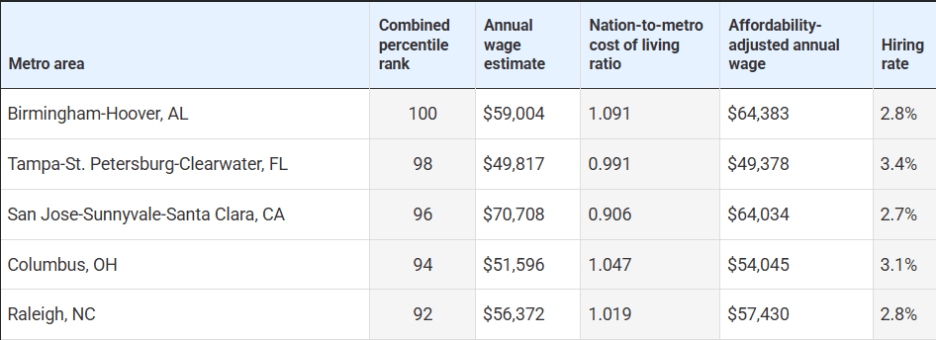
The Birmingham region ranked especially well because it offers something increasingly difficult to find in many major metros: strong career opportunities paired with a lower cost of living. According to the research, Birmingham-Hoover ranked at the top nationally in the combined analysis, supported by competitive wages and affordability-adjusted earning power.
BHM IQ
BHM IQ supplemented the ADP data for the WSJ with some illustrative insights across focal areas. Highlights are shared below.
Wages*
This region has a strong demand for college graduates with a relatively modest supply – leading to competitive wages.
Looking at population and educational attainment data for the Birmingham, Columbus (OH), and Raleigh-Cary MSAs, as well as that of the United States, Birmingham has fewer individuals over the age of 25 with a bachelor’s degree than any of these areas. More illustratively, the ratio of degree holders to the total population is also smaller in Birmingham. This is part of the story with both job availability for fresh graduates, as well as the competitive wages (strong demand, weaker supply).
| MSA | Bach/Pop
(2025) |
| Columbus, OH | 25% |
| Raleigh-Cary, NC | 31% |
| Birmingham, AL | 21% |
| United States | 26% |
<Table 2: # MSA residents over age 25 with a bachelor's degree / number of MSA residents over age 25 (expressed as a precentage)>
- The same data shows that individuals with bachelor’s degrees make up a very high proportion of Birmingham’s population increase over the past five years.
*The information in the Wages section did not go to the WSJ reporter. It was produced in response to this week’s inquiry.
Jobs
BHM IQ examined prominent local industries that generally require college or graduate degrees.
- The location quotient (LQ) for the Finance and Insurance industry in the Birmingham MSA is 1.38, signifying regional specialization and competitive advantage.
- Birmingham, specifically, saw a 39% increase in individuals employed in Computer and Mathematical occupations between 2020 and 2025, and 66% increase for Business and Financial Occupations.
- Of the regional growth in Health Care and Social Assistance (NAICS 62) from 2023 to 2024, 71% is attributed to the local industry mix share – indicating that the local industry climate is much more competitive than seen nationally.
- The LQ for Healthcare Practitioners and Technical Occupations (SOC 29-0000) is 1.3, also indicating a strong competitive advantage in the local job market relative to national. This is also the top posted occupational category regionally – with over 34,000/14,000 (total/unique) jobs posted over the preceding 6 months. These jobs are quickly filled with a 17-day median posting duration.
- In the finance industry sector as an example, subsectors like insurance, commercial banking, and investment firm management have a significant higher concentration of workers in the Greater Birmingham region than the national average. In these same subsectors, the median job posting duration is less than 25 days, whereas in regions like Atlanta, some subsector median job posting durations are recorded at 30 days or higher.
Affordability
- Birmingham’s cost of living (COL) is approximately 90% of the national average, meaning employees experience greater purchasing power compared to most large metro areas.
- Birmingham is competing with large cities like Boston (COL 151%) and Chicago (118%) for bioscience, finance, and other college-educated talent.
- It is also competing for talent across the southeast, with cities like Nashville (99%), Atlanta (94%), and Charlotte (101%).
- Rent and housing is competitively affordable in Birmingham.
| Birmingham | Chicago | Charlotte | San Francisco | Philadelphia | Washington, D.C. | |
| Apartment Rent | $1,109 | $3,492 | $1,577 | $3,985 | $2,144 | $3,229 |
Table 3: Q1 2026 C2ER cost of living data
Birmingham is a leader for large metros with homebuyers under age 25, with this demographic making up nearly 8% of homebuyers.
Building Momentum for the Future
The recognition from the Wall Street Journal reflects what many employers, graduates, and residents already know: Birmingham offers the ability to build a meaningful career without sacrificing quality of life.
As the region continues investing in innovation, workforce development, and industry growth, Birmingham is increasingly positioned as a destination where young talent can thrive professionally and personally.
Sources
- ADP Research - 2026 You’ve graduated. Now what? - ADP Research
- Constructive Coverage - Cities With the Most Homebuyers Under 25 [2024 Edition] - Construction Coverage
- C2ER cost of living data from Q1 2026
- JobsEQ data as of 2025Q3 pulled April 2026
- Lightcast – Q1 2026 Data Set pulled April and May 2026